Invest in Real Estate in Bangladesh: Turn Your Savings into Solid Assets
Bangladesh is a quick-changing, quick-growing South Asian nation with a huge population, growing incomes, and rapid urbanization. Its property market has, during the past decade, emerged as one of the most lucrative offers for investment. Foreign and Indian investors alike can only be right in investing in property properties—residential, commercial, or land—in Bangladesh cities and even peri-urban/suburban zones.
We discuss the following in this blog post:
- The macroeconomic & demographic drivers
- The primary benefits of real estate investing in Bangladesh
- Current trends & future outlook
- Risks & challenges
- Practical investment guidance on good decision-making
1. Macroeconomic & Demographic Drivers
When one arrives at fully understand why real estate investing in Bangladesh is a sure bet, it is useful to reflect upon drivers at work.
- Urbanization and population growth: Bangladesh has more than 170 million inhabitants with the proportion of individuals in urban areas on the rise. People are moving towards cities for jobs, education, health care, and a living standard in large numbers. It puts pressure on housing, infrastructure, and services.
- Emerging middle class: incomes are rising; families now comfortably accommodate high-end homes, facilities, and amenities. This requires good quality homes, gated estates, mixed use complexes, etc.
- Govt. investment & economic growth: Bangladesh has been experiencing robust GDP growth (about 6-8%) and already heavily invested in humongous infrastructure development (highways, metro railways, roads, connectivity). These extend reach and appeal of erstwhile peripheral areas.
- Remittances & foreign investment: Huge remittances are sent back by Non-Resident Bangladeshis (NRBs); part of it is invested in the real estate sector, notably Dhaka, Sylhet, and other strategic areas. Foreign interest rises with rising transparency and profitability.
Shortage of supply, particularly of housing: Demand for new housing is increasing at a faster rate than supply, particularly in Dhaka. Dhaka would need tens of thousands of new units annually but the private sector is only producing a trickle.
2. Top Benefits When You Invest in Real Estate in Bangladesh
With the above drivers, what are the net benefits an investor can derive?
A. Capital Appreciation
Then, most properties in Bangladesh—especially around or even within major cities—have been appreciating in value. More desirable is property with improved infrastructure (flyovers, metro rail, highways). Prime investment on the periphery or even in the peri-urban area = higher percentage return later when development materializes.
B. Income Property / Cash Flow
The investors get their passive income by renting offices or houses. The income is passive in well-tied cities and areas. The rent revenue is passive to most. Dhaka, in particular, experienced steady rent demand due to urbanization, career shift, students, etc.
C. Hedge Against Inflation
Bangladesh is facing inflation pressure: inputs, fuel, etc., are becoming costlier. Real property is typically a hedge: house prices rise with inflation; rents also adjust in the long term. Ownership of real assets is of real value.
D. Diversification
Property, as opposed to other stocks like bonds or shares, is tangible, something you can physically hold in your hand, which reduces risk. Property in your investment portfolio reduces overall risk. And you have sub-classes aplenty: land, residential apartments, commercial, industrial/logistics, etc.
E. Opportunities in Land & Peripheral Areas
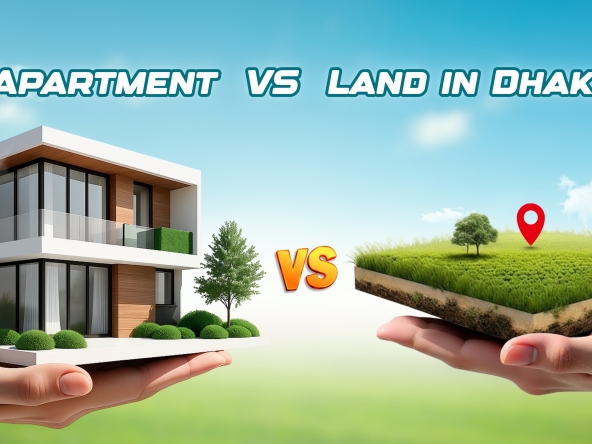
Periphery or emerging areas have comparatively lower-cost land with a good rate of returns as infrastructure gets built up. Examples: Dhaka’s periphery locations i.e. Purbachal, Keraniganj, Gazipur, Savar, Tongi. Investment at the very first phase in these areas will yield good returns.
F. Emerging Sectors & Tools
- Mixed‐use developments & commercial real estate in bangladesh: Spreading commercial demands—office space, malls, logistics—around EPZs (Export Processing Zones) and transport hubs.
- PropTech & digitization: Virtual tour, 3D model, online portal reducing buying/selling friction, transparency. Better deal for buyer, low friction.
- REITs (Real Estate in Bangladesh Investment Trusts): As evolving, REITs are investment in property without ownership/stewardship of the property. Most suited for liquidity and low entry.
G. Government & Policy Support (Some)
There are government schemes for assistance with house construction, beginning infrastructure, and incentivizing developers or house owners in some cases. National master plans (Vision 2021, Vision 2041) with the highest national priorities both encompass city planning and housing in them.
3. Trends & Promising Areas (2025 & Beyond)
Where and how to invest is as important as whether to invest.
- Satellite/suburb towns: Keraniganj, Savar, Tongi, Purbachal are taking off. With inner city land now being the limiting factor and costly to acquire, these peripheries benefit as infrastructure becomes better.
- Hubs of Dhaka: Bashundhara, Mirpur, Banani, Uttara, Gulshan — rental yield and increase in capital value both. Access is however costly.
- Mid-range & value housing / small units: Not everyone can afford luxury apartments; there is growing demand for low-rental value small apartments, studios, etc., for singles/smalls family.
- Commercial property & logistics: Growth in trade and exports (industry etc.), need for warehouses, industrial units, and office-space is on the rise.
Infrastructure development at a higher price: Metro Rail, flyovers, bridges, new highways, connectivity are opening windows everywhere which were beyond reach before. The farther distance from carried infrastructure makes them better & expensive.
4. Uncertainties & Risks
Invest in Real Estate in Bangladesh never takes place without risk. The following are the largest ones in the real estate in bangladesh situation, and how to use caution.
A.Regulatory & Policy Uncertainty
- Change in building regulations (e.g. height/density restrictions) affects profitability.
- Red tape and postponement of clearance (e.g. development plan).
B.Rising Costs & Inflation
- Cost of construction material has been increasing, squeezing margins.
- High inflation makes it unaffordable to the consumer and discourages demand at times.
C.Land Shortage & Price Saturation
- Stricter supply of locations available at middle positions; prices already very high. Entry is out of the reach of most good-position investors.
- There are several areas in the periphery that are “overdeveloped” or speculative and lack any underlying infrastructure backup and hence are unsafe.
D. Lack of Infrastructure & Services Issues
- Even where an area is presumed to have potential, inadequate road, drainage, utility, transport may limit value as well as rental demand.
- Environmental hazards: flood, drainage, global warming issues in coastal or low-lying ground.
E. Legal & Ethical Issues
- Validity of land title, licenses used, potential for forged documents are concerns.
- Developers fail to complete on time or to specifications committed to.
F. High Interest Rates / Limited Financing Alternatives
- Bangladeshi home / mortgage penetration is extremely low.
- Finance, when at all available, is costly, and repayment fees are high.
5. Smart Invest in Real Estate in Bangladesh Tips for Daily Life
To get maximum returns on investment in Bangladeshi buildings, the following tips are helpful:
A.Due Diligence
- Ensure legal status of property (title deeds, ownership, encumbrances).
- Verify approvals: city corporation, RAJUK (in Dhaka), or other concerned authorities.
- Verify reputation of developer.
B.Location, Location, Location
- Highlight nearness to infrastructure: roads, public transport, schools, hospitals, commercial areas.
- Highlight future / planned infrastructure (highways, metro lines, bridges) vs current ones—one gets access earlier for more value.
C.Rental Yield vs Appreciation Separately
- If return is the focus, look at the rental profile in the area. Rent or purchase, what can be leased on average, vacancy rate.
- For long-term capital appreciation, look at more growth prospects, city edges.
D.Do Not Look at Mixed Use & Commercial Properties
- These can be with higher returns but higher risks / more complex managing.
E.Be Cost & Timing Aware
- Account for inflation in construction cost. Account for slippages, cost overruns.
- Monitor political & macroeconomic stability (interest rate movement, inflation, foreign exchange) as they are most likely to impact cost and return.
F. Diversify in real estate in bangladesh
- Invest all cash in one asset or asset class (residential vs. commercial vs. land) is not a good idea. Diversify geographically / classes of assets.
- Be willing to use fractional units, or fractional investment (if permitted) to reduce entry cost and diversification of risk.
G.Exit Strategy
- Choose mode of sale and timing of sale: resale, long lease, or redevelopment. Markets fluctuate.
H.Professions’ Advisers
- Legal specialists, valuers of property, seasoned real estate agents.
- Accounting/tax advisers to quote the taxation implications (stamp duty, registration fee, tax on rent, capital gain etc.).

6. Case Examples & Figures
For the sake of determining the facts, some statistics and a few examples of recent history are as follows:
- Real Estate in Bangladesh size in 2024 is around US$2.68 trillion where the residential real estate was around US$2.5 trillion. The growth will be around US$3.53 trillion in 2028.
- Dhaka requires 60,000–120,000 houses per annum but the private sector supplies much lesser (around 25,000 units in certain projections), hence there is a very huge gap in house delivery.
- Rent yield of good-located or good property generally ranges from 3-5% annually for apartments sometimes higher depending on area and state of property. Plots or lands in the expanding suburbs show higher capital appreciation (8-12%) in certain instances.
- Good future locations: Purbachal, Keraniganj, Savar, Tongi, Gazipur. Good places surrounding Dhaka remain expensive but still worth it for prestige and return.
7. When & Where to Invest: 2025 Prognosis
On trends, where time and place meet to provide good investment points:
- Best Time: Now (2025) remains good time exactly because infra projects are on the horizon and there are sufficient suburbs that can be purchased at sub-market prices. Purchase pre-maturation rewards out of proportion.
- Nice Places:
- Asset Type:
- For long term appreciation, land or plots in peripheries that are growing.
- For stable income, mid-market housing flats in well-connected suburbs.
- For high risk-high return, commercial property / mixed use in rapidly developing nodes or transit-oriented locations.
Conclusion
There are some stable strengths to Bangladesh property investment: possibility of high capital appreciation, protection of rental return, protection against inflation, and benefit from desirable population and infrastructural changes. Demand is satisfactory, supply is restricted, and there is possibility in new sectors for early entrants.
But with risks: regulatory risk, cost inflation, infrastructure delay, litigations. To be successful as an investor, it is required to exercise caution: location wise choice, locking in developer and legal integrity, responsive to the finance climate, and realistic expectations of returns and time frames.
If managed well, real estate in Bangladesh can be a good instrument for generation of wealth, protection of capital, diversification of Invest in Real Estate in Bangladesh, and a part of the country’s success story.